 The art competition celebrates the beauty of endocrine science as seen through the lens of a microscope. This year’s 29 entries were judged by a panel of Society members who based their assessments on the aesthetic value of the images and their significance to endocrine research. All three winners will have their art displayed at ENDO 2026, the Society’s annual meeting, from June 13-16 in Chicago, Ill. The display will be seen by thousands of endocrine scientists and researchers from all over the world. Their work also will be featured in the Society’s magazine Endocrine News, on our website, and on social media.

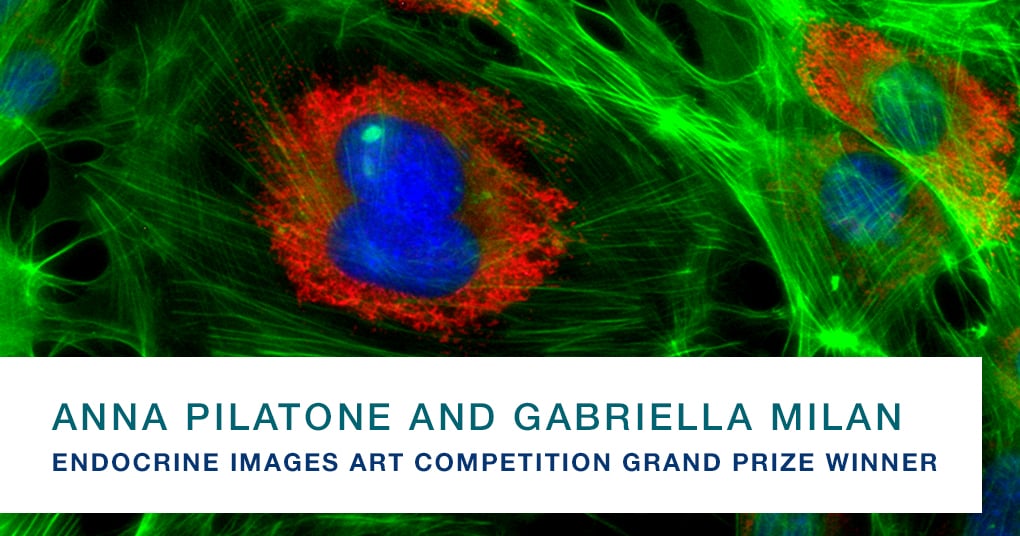
The team won for their microscopy image of a pre-adipocyte cell. Pilatone and Milan’s entry is titled “Pre-adipocyte Intriguing Scaffold.” Adipose tissue, initially described simply as body fat, has been recognized as a very complex endocrine organ characterized by different depots and composed of many cell types, including white, brown and beige adipocytes. Dysregulation of these cells causes pathological adipose tissue expansion, leading to obesity and metabolic complications such as diabetes and metabolic dysfunction-associated steatotic liver disease.
The immunofluorescence image depicts the cellular architecture of a murine pre-adipocyte used in a project aimed at investigating the role of the protein kinase CK2 in adipose tissue biology. The green cytoskeletal actin filaments and the red collagen fibers around the blue nuclei paint the fascinating complexity of the pre-adipocyte scaffold involved in the adipogenic differentiation process.
One member of the grand prize-winning team will receive complimentary registration to the Society’s annual meeting, ENDO.

The team's image features a rare fatty tumor known as a liposarcoma in the adrenal gland. They note that retroperitoneal liposarcomas are often aggressive and may present to the endocrinologist as an adrenocortical carcinoma. Microscopic examination revealed a malignant mesenchymal neoplasm composed of two distinct components. The well-differentiated component is characterized by adipocytic cells of variable size separated by fibrous septa containing atypical spindle cells. The second component shows dedifferentiated areas composed of spindle and pleomorphic cells embedded in a collagenized stroma with focal necrosis, infiltrating the adrenal gland. Immunohistochemical analysis demonstrated expression of p16, CDK4, and MDM2. These findings indicate a dedifferentiated liposarcoma involving and infiltrating the adrenal gland.

Cedeño-Rosario submitted an image of the mitochondria in the kidney’s proximal tubular epithelial cells. The “Maze of Mitos” science art piece is a confocal microscopy image representing the complexity of the mitochondrial network in renal proximal tubular epithelial cells. Herein, we can appreciate the beauty of the mitochondria “the powerhouse of the cell”. The mitochondria are one of the most interesting and important organelles in the cell for the production of energy and it is shown here in green, while the cytoskeleton of the cell is shown in gray and the nucleus in blue.

Description of work: The nuclei counterstain of this image illustrates the tissue architecture including the crypt-villus axis and the lamina propria of the mouse distal small intestine. The RNAscope in situ hybridization of the epithelium captures RNA localization of an amino acid hydrolysis enzyme, Aspartoacylase or Aspa (magenta), previously only studied in the central nervous system. Aspa appears exclusively in the mid-villus enterocytes precisely zoned to amino acid sensing regions of the intestinal epithelium. Lastly, enteroendocrine cells marked by ChgA (green) are interspersed through the epithelial lining and are excluded from Aspa+ enterocytes. Outside the central nervous system, Aspa nominates novel roles at the intersection of enterocyte differentiation and nutrient absorption.

Description of work: The embryonic mouse ovary at day 18.5 — caught in a moment most eyes will never see. The organ itself has settled into the shape of a heart, as if quietly announcing its purpose. Scattered within are glowing jade pearls (MVH, green), germ cells in the final steps of being enclosed into primordial follicles. E-cadherin (red) lines the membrane of each germ cell, the molecular handshake between oocyte and somatic neighbor that holds this first assembly together. Tiny magenta stars (γH2AX) flicker inside — each one a brief, burning moment of meiotic DNA rewriting. DAPI (cyan) paints every cell nucleus, unveiling the vast cellular universe within which these jade pearls are cradled.
Scale bar = 100 µm

Description of work: 90% of vitamin E, an essential fat-soluble micronutrient, is stored within white adipose tissue depots. Studies of liver steatohepatitis have also shown that excess liver fat can trap vitamin E. Furthermore, increasing BMI is correlated with lower circulating vitamin E levels. Together, this may explain why the well-known antioxidant effects of vitamin E fail to produce meaningful clinical endpoints through attempts at supplementation in settings of chronic metabolic disease including obesity and type 2 diabetes. Although it's been known that vitamin E is predominantly stored in adipose tissue, this image is the first to visualize the exclusive deposition of vitamin E within the lipid droplets of mature adipocytes. Mouse embryonic fibroblasts, 3T3 cells, were differentiated into mature adipocytes before being treated with a fluorescent analogue of vitamin E, BODIPY-alpha-tocopherol (green). The lipid membranes are indicated by perilipin staining (red) and nuclei are stained with DAPI (blue). The ability to visualize the fate of vitamin E will help unveil the specific mechanisms required for vitamin E release from its primary storage site. This is a majorly understudied area of research. Identifying the elements required for vitamin E liberation will also inform us of pathways operant in maintaining nutrient pools in adipose tissue.

Description of work: Sympathetic nervous system PRV152 (green) and sensory H129 (red) viruses in were injected intra-inguinal white adipose tissue. After five days, the viruses labeled the whole neuroaxis with the hypothalamic center in the PVH (paraventricular hypothalamic nucleus). Conclusion: we revealed crosstalk between sympathetic and sensory innervations of white adipose tissue.

Description of work: A cross-section of the ovary stained for CD31 (green, vessels) and MSY2 (red, oocytes), with nuclei counterstained in blue. The image shows follicles at multiple developmental stages, from primordial to antral, together with the ovarian vascular network. This organization highlights the close relationship between folliculogenesis and vascular support, which is essential for hormone delivery and endocrine regulation of ovarian function.