EFL Episode 079

For our 79th episode, we review a recent Journal of Clinical Endocrinology & Metabolism (JCEM) article on incidental physical activity, the everyday movement outside of structured exercise. Many patients now track this activity with wearable devices, and clinicians often aren't sure what to do with that data. The study used wrist accelerometer data from nearly 23,000 UK adults who reported that they don't exercise. It found that just a few minutes a day of vigorous incidental activity was linked to a lower risk of type 2 diabetes. The findings also question the guideline assumption that 1 minute of vigorous activity equals 2 minutes of moderate activity. Host Chase Hendrickson, MD, MPH, MHCC, from Vanderbilt University talks with regular contributor Diana Soliman, MD, from the University of Miami, and guest expert Jane Reusch, MD, from the University of Colorado. They discuss a study by Sabag et al., published online in September 2026 in JCEM titled, "The dose-response association between wearables-quantified incidental physical activity and type 2 diabetes: a prospective cohort study."

Meet the Speakers
Regular Contributor
Diana Soliman, MD, MHS
University of Miami Miller School of Medicine
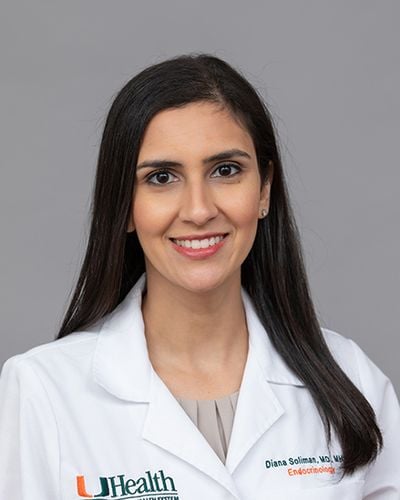 Diana Soliman, MD, MHS, received her medical degree from the University of Miami Miller School of Medicine. She completed her Internal Medicine-Pediatrics residency at the University of Miami/Jackson Memorial Hospital, where she also served as chief resident. She completed her fellowship training in endocrinology at Duke University and earned a Master of Health Sciences in Clinical Research from Duke University. Dr. Soliman serves as Associate Program Director of the Internal Medicine Residency Program at the University of Miami/Jackson Memorial Hospital. She is also the Principal Investigator of the Miami site for the Diabetes Prevention Program Outcomes Study (DPPOS). Her career interests include diabetes prevention and management, obesity, and medical education.
Guest Expert
Jane E. B. Reusch, MD, FAHA
University of Colorado Anschutz Medical Campus
 Jane E. B. Reusch, MD, FAHA, is Professor of Medicine, Bioengineering, and Integrative Physiology at the University of Colorado Anschutz Medical Campus. She is Associate Director of the Ludeman Family Center for Women’s Health Research and holds the Amy Davis Chair in Diabetes and Women’s Health Research. Dr. Reusch also serves as a Staff Physician and Merit Review Investigator at the RMRVAMC.
A physician scientist, Dr. Reusch has made foundational contributions to understanding cellular metabolism in diabetes and its complications through studies in humans, as well as cell and animal models. Her clinical research program, in collaboration with Drs. Regensteiner and Nadeau, focuses on exercise intolerance in adults and youth with type 1 and type 2 diabetes, with particular emphasis on sex based differences and the disproportionate impact on women.
Dr. Reusch is an elected member of the ASCI and AAP and has received numerous honors, including the Women of Valor in Diabetes Award, The Endocrine Society Laureate Award for Mentoring, the Banting Medal for Leadership and Service, Albert Renold Award and the Edwin Bierman Award from the American Diabetes Association. She served as President for Medicine and Science of the ADA and as a member of its Professional Practice Committee, contributing to the Standards of Medical Care in Diabetes, and is a strong advocate for equitable, sex-specific, evidence based diabetes care.
 Chase Hendrickson, MD, MPH, MMHC, practices general endocrinology at the Vanderbilt University Medical Center, where he is an associate program director for the endocrinology fellowship program. His interests include endocrine education, teaching inferential methods, and quality improvement.